
A New Generation of Research Leaders Takes Shape
Danish Diabetes and Endocrine Academy (DDEA) is allocating DKK 36.8 million in 39 new research projects, including 17 PhD scholarships, 15 p...
Posted on December 4, 2025

Although Luke Johnston didn’t accomplish his initial goals for his DDA postdoctoral fellowship, the challenges he faced ultimately guided him to his dream project.
Luke Johnston came to Denmark hoping the country’s well-known data registers would further his research in diabetes epidemiology. Now, he leads an ambitious project developing a new framework for health data, but the journey was far from smooth.
Luke Johnston has a PhD in nutritional sciences from the University of Toronto, Canada. Working with complex data sets, he soon developed an interest in data management.
“I get stressed without structure, and data can get messy when not organised properly. So, I spent a lot of time learning how to manage my data, which required learning programming. From there, my interest in programming and data engineering kept growing,” says Luke Johnston.

Luke came to Denmark to advance his research in diabetes epidemiology with the country’s renowned registers, receiving a postdoc fellowship from Danish Diabetes Academy, now Danish Diabetes and Endocrine Academy (DDEA), at Steno Diabetes Centre Aarhus and Aarhus University. Luke Johnson’s postdoc project, ‘The metabolic consequences of adverse early life conditions and sub-sequent risk for adult type 2 diabetes’, required access to data, primarily from Statistics Denmark.
This, however, proved to be more challenging than Johnston anticipated.
Statistics Denmark is a governmental organization overseeing Danish statistics. For Luke Johnston, accessing data from Statistics Denmark was a significant hurdle.
“The Danish register data is a valuable resource, so it’s understandable to be cautious when granting access. However, my difficulties with Statistics Denmark stemmed more from their data organisation and the application process. It was manual, filling out Word templates and sending emails. In addition, the details were unclear – some variables were not well documented in the data sets. Though they’ve improved since then, it took over a year and a half to get my data,” explains Luke Johnston.
Due to delays and the COVID-19 pandemic, Johnston ended his postdoc without significant publications. Nevertheless, he made his materials, including the registers and variables requested in the application to Statistics Denmark, available online through the DARTER project.
“I am an advocate for open science and practice what I preach. I don’t want others to go through the same frustrating process I went through if I can help it,” says Luke Johnston.
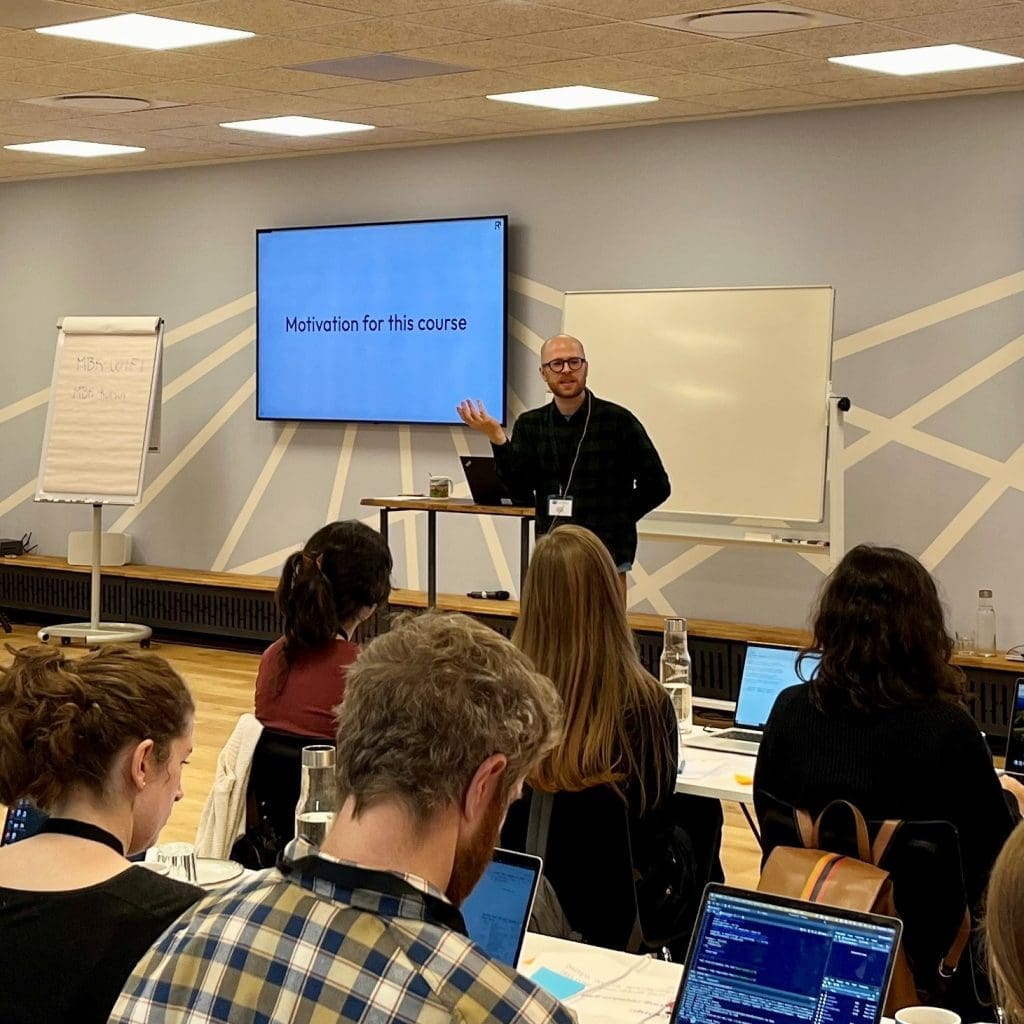
When Luke Johnston approached DDEA with the idea of creating a course in R programming, he already had experience teaching it to his peers at the University of Toronto.
“DDEA was willing to give it a go, even though they were skeptical of the demand. The first introductory course filled up quickly, so we set up more courses. Then, people asked for more advanced levels, so, in time, we also created an intermediate and an advanced course. I’ve been running them every year since 2019, and they’re still going strong,” says Luke Johnston.
In fact, they have turned out to be some of DDEA’s most popular courses.
R is a free software using the R programming language for statistical computing and data visualization. Luke Johnston has published all the material for the DDEA R courses online, with nearly 25.000 combined visits per year from across the world to the three different course websites, proving that there is indeed a demand.
“At universities, the instruction on tools like data software can be lacking, and often not grounded in the science of learning. With DDEA, I can apply the science of learning. And because DDEA funds it, we get a nice venue and good food, so it’s also very much about networking,” says Luke Johnston.
For the last two years, Luke Johnston has worked on his dream project – one he was brought into because of his expertise, teaching experience, and first-hand challenges with Statistics Denmark. He is the Team Leader in the Novo Nordisk Foundation-funded Seedcase Project, a framework for an open and scalable infrastructure for health data.
“The Seedcase Project aims to create a software tool for researchers to structure their data according to best practices for data engineering. This helps them store their data more coherently, making it easier for others to access, like PhD students. Issues with structuring data are not just prevalent in academia but in industry, too. The second pillar of the project is teaching, so we’ll be developing courses on data structuring and analysis,” says Luke Johnston.
Johnston hopes the project will continue beyond its initial funding due to its potential for ongoing consulting, training, and support.
If there is one thing Luke Johnston’s journey proves above all else, it is that a successful science career does not always follow the traditional metrics.
“Many researchers get stuck on the postdoc-to-professor pipeline, but there are other options in industry or even in unconventional academic roles. If you’re frustrated by a lack of results, keep going. Once you find the right project, no one will care about your publication record—they’ll care about what you can contribute,” concludes Johnston.
Do you want to join one of our courses with Luke Johnston on reproducible research in R? DDEA has two courses that are currently open for registration: One introductory course, and one advanced course.
Introductory Course
Event date: 14 January 2025
Introductory Course on Reproducible Research in R
Registration deadline: 1 December 2024
Advanced Course
Event date: 12 December 2024
Reproducible Research in R: An advanced workshop on creating collaborative and automated analysis pipelines
Registration deadline: 3 November 2024
Priority is given to participants employed at Danish institutions and in the Danish life science industry. If the event is overbooked, the DDEA reserves its right to select participants based on the defined requirements and country of employment.
Luke Johnston, MSc, PhD
Clinical Researcher, Team Leader
Steno Diabetes Center Aarhus (DK)
lwjohnst@ph.au.dk





EAN: 5798 0022 30642
Reference: 1025 0006
CVR: 29 19 09 09


